

Cargo Aircraft and Their Importance for Global Logistics
Skyline Express: Cargo Aircraft in Global Logistics
Reading time: 4 Minutes
Not Pie in the Sky:
Cargo Aircraft and Their Importance for Global Logistics
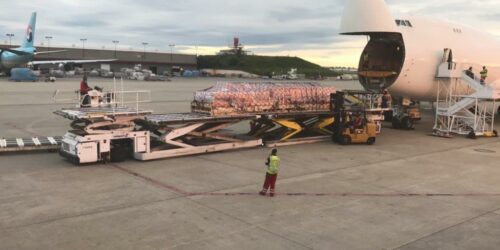
When we think of global logistics, many people first picture huge container ships. Understandably so. These floating steel cities transport gigantic quantities of goods across the world’s oceans and are indispensable to international trade. But when speed really matters, when supply chains start to falter or important sea routes can no longer be used as usual, another mode of transport moves into focus: the cargo aircraft. Cargo aircraft are something like the sprinters of global logistics. They transport less volume than ships, but they are much faster, more flexible and less dependent on maritime bottlenecks. That is exactly why they play a central role for companies, industry, trade and healthcare
Air Freight: When Speed Matters
Of course, nobody would generally think of sending low-cost mass-produced goods halfway around the world by aircraft. Air freight is too expensive for that, and capacity is limited. But air freight becomes especially valuable whenever time matters more than the pure transport cost. Typical examples include urgently needed spare parts, medical products, temperature-sensitive goods, important documents, high-value electronics, sample deliveries or components for ongoing production. When a machine is at a standstill, a hospital is waiting for a product or a project deadline is at risk, the cheapest transport route is no longer the only thing that matters. What matters is that the shipment arrives safely, reliably and quickly. This is where cargo aircraft show their strength. They connect continents within a few hours instead of several weeks. They make international supply chains more resilient and help companies remain operational, even when disruptions occur somewhere in the world.
“Air freight strengthens Germany as a business location: around 5 million tonnes of cargo are handled here every year. The value of the foreign trade goods transported amounts to approximately 340 billion euros.” [1]
Cargo Aircraft Become More Important in Times of Crisis
Global logistics sounds like endless possibilities. In reality, however, many flows of goods pass through surprisingly few bottlenecks. These include the Suez Canal, the Red Sea, the Strait of Hormuz, the Strait of Malacca and the Panama Canal. These waterways are extremely important for global trade. At the same time, they are vulnerable. A blocked canal, political tensions, security risks, low water levels or military conflicts can be enough to disrupt supply chains around the world. The past has shown this several times.
If the Suez Canal or the route through the Red Sea is avoided, ships often have to take the long detour around the Cape of Good Hope. That costs time, fuel, capacity and nerves. If the Strait of Hormuz becomes unsafe, this affects not only energy and raw material markets, but also many downstream supply chains. For companies, this means that a transport plan that looked perfect yesterday may already be obsolete tomorrow. Delivery dates are pushed back, containers end up in the wrong places, freight rates rise and production chains come under pressure. In moments like these, air freight does not automatically become the standard solution for everything. But it becomes the decisive alternative for everything that cannot wait.
“Cargo aircraft cannot replace a container ship. That would be a bit like trying to move house with a sports car.”
Air Freight as the Ideal Complement
For large quantities, sea freight is unbeatable. But when important waterways cannot be used reliably, the question changes: What absolutely has to arrive quickly? Which parts secure production? Which shipments have priority, and which delay would be more expensive than transport by air freight? That is when the strength of air freight comes into play. It creates alternatives when maritime routes are overloaded, unsafe or blocked. It helps prioritize critical shipments. And it enables companies to keep delivering, producing or supplying customers despite international disruptions. This applies in particular to industries with highly synchronized processes. In the automotive industry, missing components can stop entire production lines. In medical technology, delays can have a direct impact on patient care and treatment. In mechanical engineering, a missing spare part can become a real cost factor. And in e-commerce, customers have long come to expect delivery times that make you wonder whether the parcel was dispatched before the order was even placed.
“Measured by weight, air freight plays only a small role in global goods transport. But when you look at the value of the goods, the picture changes completely: around 35 percent of the globally transported value of goods is moved by aircraft.”[2]
Cargo Aircraft Are Part of a Smart Logistics Strategy
Modern logistics is not about choosing a single mode of transport. It is about finding the right solution depending on the shipment, urgency, risk and budget. In many cases, the cargo aircraft is then the best option, or even the only realistic one. Especially in uncertain times, this flexibility becomes increasingly important. Today, companies not only need to transport goods cost-effectively, they also need to plan resiliently. Supply chains need alternatives. Transport routes must be reassessed. And logistics partners must be able to respond quickly when conditions change.
This requires experience, communication, a reliable network and the ability to stay calm even when requirements arise at short notice. Because when a shipment is urgent, panic rarely helps. A good solution does.
“For Skyline Express, this is precisely the core of modern express logistics: not simply moving goods from A to B, but finding the right route at the right moment.”
Air Freight Keeps the World Moving
Cargo aircraft are not a replacement for sea freight. But they are an indispensable part of global logistics. They bring speed to supply chains, create alternatives during international disruptions and ensure that important shipments still reach their destination when other routes become more difficult. Especially when waterways such as the Strait of Hormuz or the Suez Canal cannot be used as usual, the value of air freight becomes particularly clear. Then it is not just about speed, but about security of supply, predictability and economic agility. In short: container ships move the masses. Cargo aircraft move what cannot wait. And that is exactly why they are becoming increasingly important in a connected, yet disruption-prone world.
Do you have questions about air freight or would you like to talk to us about your goals? We will be happy to advise you personally.
[1] https://www.bdl.aero/wp-content/uploads/2024/07/2023-studie-bedeutung-der-luftfracht.pdf
[2] https://www.bpb.de/kurz-knapp/zahlen-und-fakten/globalisierung/52528/luftfracht/
Mit Skyline Express erreichen Sie Ihre Ziele.
Ob Seefracht, Luftfracht, Landverkehr oder komplexe Logistiklösungen – unser Team sorgt für reibungslose Abläufe, schnelle Transporte und volle Transparenz entlang der gesamten Lieferkette. Vertrauen Sie auf Erfahrung, Dynamik und digitale Effizienz.
