

Lesedauer: 5 Minuten
Why a Narrow Waterway Moves the Global Economy
When people think of global logistics, they often picture massive container ports, kilometer-long freight trains, or fully automated warehouses. What many underestimate is this: sometimes a waterway just 40 kilometers wide determines whether supply chains run smoothly—or grind to a halt.
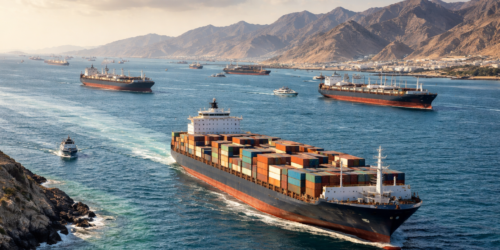
We are talking about the Strait of Hormuz. A geographically small bottleneck with enormous importance for global trade, energy supply, and international transport flows.
Where Exactly Is the Strait of Hormuz Located?
The Strait of Hormuz connects the Persian Gulf with the Gulf of Oman and, indirectly, the open waters of the Indian Ocean. Iran lies on one side, while the United Arab Emirates and Oman are on the other.
Sounds like a geography lesson? Perhaps. But economically speaking, this passage is one of the most important locations in the world.
Why This Strait Is So Important to the World
Every day, vast quantities of crude oil, liquefied natural gas, and petrochemical products pass through the Strait of Hormuz. Estimates suggest that around one-fifth of the world’s traded crude oil moves through this single passage.
This means: if something happens here, the entire global economy feels it. Not eventually—immediately.
Rising oil prices, fluctuating freight rates, delays in production chains—all of these can originate in this one region. For logistics companies, the Strait of Hormuz is therefore not merely a geopolitical issue, but a very real operational risk factor in day-to-day business.
A True Bottleneck in Global Supply Chains
Today’s global logistics system follows a simple principle: speed through connectivity. Raw materials are sourced worldwide, components are manufactured internationally, and finished products are sold globally.
For this system to function, transport routes must remain reliable. The Strait of Hormuz is a classic example of a logistical “single point of failure.” If this corridor is disrupted or restricted, immediate detours become necessary. The result:
- longer transit times
- higher fuel costs
- overloaded alternative routes
- rising insurance premiums for shipping companies
The challenge is that bypassing the region is hardly possible without risking significant impacts on delivery times and costs.
When Geopolitics Meets Logistics
Logistics is no longer just about organizing transport. It is about risk management.
The Strait of Hormuz lies in a geopolitically sensitive region. Tensions, military presence, or political conflicts can influence maritime traffic at any time. Even minor incidents are enough to unsettle markets.
For shippers and logistics providers like Skyline Express, this means one thing: planning certainty can no longer be taken for granted.
Modern logistics must be flexible. Companies need alternative routes, resilient partner networks, and transparent communication across the entire supply chain. This is where experience and international connectivity become critical success factors.
What This Means for European Companies
Many companies in Germany and across Europe assume that conflicts in the Middle East are geographically distant. In reality, developments in the Strait of Hormuz have a direct impact on domestic industries.
- Chemical companies depend on raw material deliveries
- Machinery manufacturers require intermediate goods
- Automotive suppliers are affected by energy prices
- Trading companies must recalculate transport costs
Even minor delays can shift production schedules or affect profit margins. The Strait of Hormuz is therefore an invisible factor in almost every supply chain—even when the goods themselves never physically pass through the region.
The Role of Modern Logistics Providers
In the past, logistics companies primarily organized transportation. Today, companies like Skyline Express increasingly take on strategic responsibilities. These include:
- risk analysis of international trade routes
- monitoring geopolitical developments
- flexible transport planning
- combining different modes of transport
- rapid response to market changes
Sensitive routes such as the Strait of Hormuz clearly illustrate the difference between a traditional freight forwarder and a modern logistics partner.
Today, companies expect more than transport capacity. They expect guidance in an increasingly complex global environment.
Why Resilience Is the New Key Term
Recent years have shown how vulnerable global supply chains can be. Pandemics, port closures, blockages of critical waterways, and political tensions have triggered a fundamental rethink.
Resilience has become one of the central goals of international logistics strategies.
This means that not only the fastest route matters—but the safest and most flexible one.
Companies are diversifying their supply chains, distributing risks across multiple regions, and developing alternative scenarios. Nearshoring and regional production are also gaining importance in reducing dependencies.
The Strait of Hormuz remains a prime example of how strongly individual geographic chokepoints can influence the global economy.
A Look Ahead: Will the Strait of Hormuz Remain a Risk?
In short: yes—and at the same time, it will remain an indispensable lifeline of global trade.
As long as a significant share of the world’s energy supply comes from the Gulf region, the Strait of Hormuz will continue to play a central role. At the same time, governments and companies are increasingly investing in alternative energy sources, new trade routes, and more resilient supply chains.
Yet even as the energy transition progresses, global trade remains deeply interconnected. And this leads to the key insight: logistics has long become a strategic success factor for companies.
Conclusion: A Small Strait with a Big Impact
The Strait of Hormuz is more than a geographical point on the map. It symbolizes how closely economics, politics, and logistics are intertwined today.
A narrow waterway influences energy prices, transport costs, production planning—and ultimately even the availability of everyday products.
For logistics providers like Skyline Express, this means understanding global developments, identifying risks early, and guiding customers reliably through an increasingly complex trade environment.
Because successful logistics does not begin with transportation—it begins with understanding global interconnections.
And sometimes, a single narrow strait determines whether supply chains flow—or stall.
Do you have questions about this topic or would you like personal advice? Our team will be happy to assist you.
Mit Skyline Express erreichen Sie Ihre Ziele.
Ob Seefracht, Luftfracht, Landverkehr oder komplexe Logistiklösungen – unser Team sorgt für reibungslose Abläufe, schnelle Transporte und volle Transparenz entlang der gesamten Lieferkette. Vertrauen Sie auf Erfahrung, Dynamik und digitale Effizienz.
