

Logistics: Bridging the Gap Between Europe and Africa
Two Continents. Growing Trade Relations.
Reading time: 2 Minutes
Logistics: Bridging the Gap Between Europe and Africa
Europe and Africa are separated by just 14 kilometres at the Strait of Gibraltar. Economically, however, the two continents can seem worlds apart. Different infrastructure systems, customs regulations and transport conditions present businesses with significant challenges. At the same time, trade relations are developing rapidly. International logistics plays a key role in this process, connecting markets, securing supply chains and laying the foundation for closer economic cooperation.
Two Continents. Growing Trade Relations.
Africa is becoming increasingly important to European businesses. The continent not only supplies essential raw materials and energy resources but is also emerging as an attractive manufacturing location and sales market. New economic partnerships are developing, particularly in industries such as automotive manufacturing, mechanical engineering, renewable energy and agriculture. The European Union is already Africa’s largest trading partner. Trade between Germany and African countries is also growing. According to Germany Trade & Invest, Germany’s foreign trade with Africa reached a record high[1] of €63.4 billion in 2025 – an increase of 10.5% compared to the previous year. Germany exported goods worth €28.4 billion to Africa, including vehicles, machinery and industrial products. At the same time, German businesses imported approximately €35 billion worth of goods from African countries, including energy resources, raw materials and agricultural products.
These figures clearly demonstrate that Africa has long been more than just a supplier of raw materials to the German economy. The continent offers attractive sales markets, manufacturing opportunities and considerable potential for long-term partnerships.
From South Africa to Morocco: Germany’s Key Trading Partners
However, economic relations vary considerably between individual African countries. While some are already closely integrated into international supply chains, others are still developing their industrial infrastructure and export industries. South Africa is Germany’s most important trading partner on the African continent. Cooperation is particularly strong in the automotive industry. German manufacturers and suppliers operate production facilities in the country and depend on reliable international supply chains. North Africa also plays a central role. Countries such as Morocco, Egypt and Tunisia have established themselves as important business locations. Morocco, in particular, is closely integrated into European production networks. Its geographical proximity to Europe enables relatively short transport routes and facilitates cooperation between businesses on both continents. West African markets are also becoming increasingly attractive. German exports to the region rose by almost 25% in 2025. Nigeria, Ghana and Côte d’Ivoire, in particular, offer considerable potential for trade in machinery, technical equipment and other industrial goods.[2]
Logistics as a Key Driver of Economic Growth
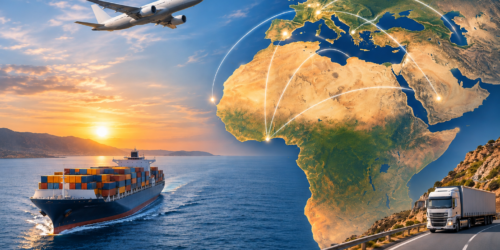
Whether machinery from Germany, automotive components from Morocco or agricultural products from Africa, international trade on this scale would hardly be possible without efficient transport and logistics chains. Today, logistics involves much more than simply moving goods from one place to another. International logistics combines different modes of transport, coordinates the flow of goods and ensures that products reach their destinations reliably, cost-effectively and as close to schedule as possible. Sea freight plays a particularly important role. It forms the backbone of intercontinental trade, enabling large volumes of goods to be transported economically. Major seaports such as Tanger Med in Morocco, Durban in South Africa and Abidjan in Côte d’Ivoire provide access to international markets. For time-critical shipments, high-value components or urgently needed spare parts, air freight offers an important alternative. International transport routes are complemented by road and rail networks, connecting ports, airports, production facilities and final destinations.
The key lies in the seamless integration of all modes of transport. Only when transportation, cargo handling, warehousing and customs clearance work together can efficient and reliable supply chains be established.
Different Markets. Unique Challenges.
Africa’s economic potential is enormous, but its logistics landscape is equally diverse. After all, the continent comprises 54 countries, each with its own regulatory requirements and, in some cases, significant differences in transport infrastructure. While some regions benefit from modern ports, efficient transport networks and well-developed logistics centres, others face challenges such as long transport distances, limited capacity and complex customs procedures. For internationally operating businesses, this makes careful transport planning essential. In addition to selecting the appropriate modes of transport, country-specific regulations, the necessary documentation and professional customs clearance all play a crucial role. Reliable local partners are equally important. They understand the respective market conditions, can identify potential difficulties at an early stage and help ensure that shipments are handled efficiently.
Looking Ahead: New Trade Routes and Stronger Connections
Economic cooperation between Europe and Africa is expected to become increasingly important in the coming years. Key drivers include investment in industry and infrastructure, the development of new manufacturing locations and the expansion of renewable energy. At the same time, the African Continental Free Trade Area (AfCFTA) is opening up new opportunities. The initiative aims to reduce trade barriers within Africa and facilitate economic exchange between its member states. The European Union is also supporting investment in infrastructure and international transport connections through its Global Gateway initiative. These developments present new opportunities and challenges for the logistics industry. Efficient transport networks, digital shipment tracking solutions and flexible logistics concepts tailored to different markets and requirements will become increasingly important.
One thing is clear: The closer the economic ties between Europe and Africa become, the greater the need for reliable logistics solutions that connect the two continents.
Skyline Express: Connecting Markets Through International Logistics
Cross-border trade requires experience, reliable partners and well-planned transport solutions. This is exactly where Skyline Express comes in. For more than 25 years, we have been developing customised solutions for international cargo flows. With our expertise in sea and air freight, road transport, warehousing and customs clearance, we help businesses manage even complex supply chains safely and efficiently. Our customers benefit from an international network of trusted partners and our extensive expertise in global logistics. Our strong connections across the African continent are also reflected in our recognition as Top Agent 2023 by the Africa Logistics Network (ALN).
Because successful trade relations require more than just good business ideas. They depend on connections you can rely on.
Mit Skyline Express erreichen Sie Ihre Ziele.
Ob Seefracht, Luftfracht, Landverkehr oder komplexe Logistiklösungen – unser Team sorgt für reibungslose Abläufe, schnelle Transporte und volle Transparenz entlang der gesamten Lieferkette. Vertrauen Sie auf Erfahrung, Dynamik und digitale Effizienz.
